The Next
Justified Enterprise
Do not design the final AI enterprise.
Design the next enterprise that the evidence justifies.
AI is changing what enterprises can do faster than many organizations can responsibly redesign around it. The leadership challenge is deciding whether the current configuration remains sufficient, and what depth, scope, and timing of change the evidence justifies next.
Is the current configuration
still sufficient?
Material AI capability or environmental change that could plausibly alter the required outcome or consequential configuration should trigger reassessment, not automatic redesign.
The prior question is whether the current configuration can still produce the required outcome under current conditions. The answer determines whether leadership should preserve, prove, or reconfigure.
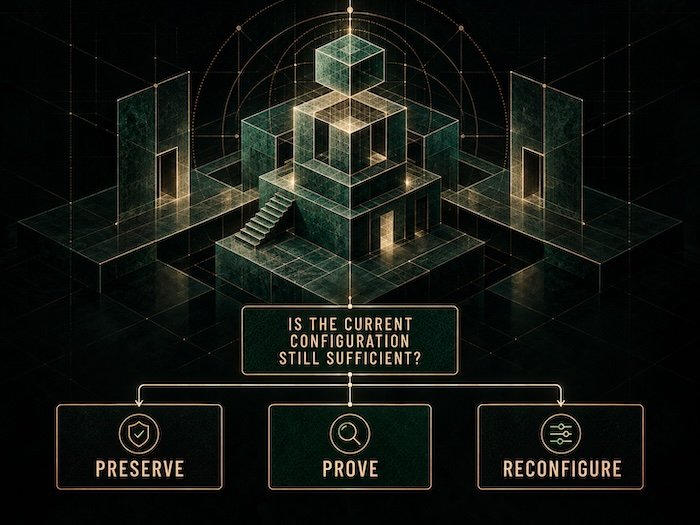
From capability change to justified action
The Sufficiency Gate helps leaders decide what action the evidence actually justifies next.
If the current configuration remains sufficient, preserve what works and improve locally. If evidence is uncertain, prove actively: test, learn, and reduce uncertainty before deeper commitment, while accounting for the cost of delay, including foregone learning and strategic preemption. If the configuration has become insufficient, selectively reconfigure to the depth, scope, and timing the evidence justifies.
What should leaders examine before deciding to change?
Sufficiency is not a single metric. It is a judgment about whether the current configuration can still produce the required outcome while meeting the material requirements that matter for the decision. Four lenses help structure that judgment.
Value
Does the configuration produce outcomes that matter, not merely activity, output, or local efficiency?
Coherence
Do work, decisions, accountability, information, and technology still fit together as a functioning system?
Continuity
Can the enterprise adapt without unnecessarily weakening capabilities, learning, context, relationships, or recovery mechanisms that still matter?
Optionality
Does the next move preserve appropriate freedom to learn, recover, or change direction without allowing delay itself to destroy material value or opportunity?
The future enterprise is a sequence of justified configurations.
AI capability can move materially within the time it takes an enterprise to design, approve, implement, and absorb organizational change. That makes it increasingly difficult to treat one detailed AI operating model as a final destination.
A more durable approach is to treat enterprise design as a sequence of justified configurations: each one supported by the evidence available for the outcomes and conditions that matter, and each one open to reassessment as capability, evidence, and conditions change.

Direction can endure. Detailed commitments should remain revisable.
A decision principle, not a prediction of the final enterprise.
The Next Justified Enterprise is a managerial synthesis for making proportionate organizational decisions as AI capability, evidence, and operating conditions change.
What it proposes
Organizations should reassess when capability or conditions materially change, ask whether the current configuration remains sufficient, and then preserve, prove, or selectively reconfigure according to the evidence.
What it does not claim
It is not a universal theory, a maturity model, a fixed target architecture, or an argument that every meaningful AI gain requires enterprise transformation.
The discipline is not to change less. It is to change with justification.
EXECUTIVE MAP
A one-page visual summary of the core logic, the Sufficiency Gate, and the four lenses.
The Next
Justified Enterprise
Why Enterprise AI Transformation needs a decision discipline between technological possibility and organizational redesign
Enterprise AI Transformation is beginning to confront a more difficult question than adoption.
For the first few years of generative AI, much of the enterprise conversation could be framed around tools. Which models should we use? Where can copilots improve productivity? Which processes can be automated? What governance is needed? How should employees be trained? Where can AI reduce cost or increase speed?
Those questions still matter. But they are no longer sufficient.
As AI begins to affect workflows, decision rights, expertise, management layers, knowledge flows, customer interactions, workforce composition, and the economics of entire functions, the question changes.
Leaders are no longer deciding only where AI should be used.
They are deciding what kind of organization should exist around increasingly capable AI.
That is a much more consequential problem.
A successful pilot may suggest that a workflow can be redesigned. A new agent may perform work that previously crossed several functions. A team may suddenly produce more output with the same number of people. A capability that appeared unrealistic six months ago may become technically feasible.
But what organizational conclusion should follow?
Should the enterprise immediately redesign the surrounding process?
Should authority move?
Should roles disappear?
Should headcount change?
Should a target operating model that was approved six months earlier be reopened?
Or should the organization first learn more about reliability, exceptions, economics, capability loss, accountability, and the downstream consequences of the new technology?
There is no universal answer.
And that is precisely the problem.
But permanent redesign would be an equally serious mistake
It is tempting to respond to rapid technological change by arguing that enterprises should simply become permanently adaptive. That sounds attractive until one considers what constant reconfiguration actually costs.
Organizations accumulate value through stability as well as change.
Expertise deepens.
Trust develops.
Teams learn how to work together.
Accountability becomes understood.
Informal coordination improves.
Customers become familiar with interfaces.
Organizational memory accumulates.
Capabilities become institutionalized.
Investments begin to compound.
An enterprise that continually redesigns itself around every significant improvement in AI may become technically contemporary while remaining organizationally immature.
There is therefore a symmetry to the problem.
One failure mode is underreaction:
The organization continues inserting increasingly capable AI into structures designed around older assumptions about information, expertise, coordination, and scarcity.
The technology improves, but the surrounding enterprise does not.
Decision rights remain unchanged.
Approval structures survive because they have always existed.
Work remains divided according to old assumptions.
New productive capacity appears, but the organization cannot convert it into better economics, service, resilience, quality, or strategic advantage.
Eventually the configuration itself becomes the constraint.
The other failure mode is overreaction:
Every significant technical gain is interpreted as evidence that the organization is obsolete.
A pilot becomes a workforce strategy.
A productivity result becomes an operating-model conclusion.
A successful demonstration becomes justification for removing capabilities whose less-visible organizational functions were never examined.
Change capacity is repeatedly consumed before the consequences of earlier redesigns have matured.
The enterprise becomes highly responsive to technology and increasingly unstable as an organization.
Neither condition is desirable.
So the governing question should not simply be:
How quickly can we transform?
Nor:
How much can we preserve?
It should be:
What does the evidence actually justify changing now?
That question is the starting point for The Next Justified Enterprise.
The problem is older than AI
The underlying intellectual territory is well established.
The Next Justified Enterprise does not begin from the assumption that organizational adaptation has somehow been discovered in the age of generative AI.
Long before contemporary AI, organization scholars were examining the relationship between technology, uncertainty, information, learning, and organizational design.
The socio-technical tradition associated with Eric Trist and colleagues demonstrated that technological systems and social systems cannot be optimized independently. Changes in technology alter roles, relationships, coordination, and the structure of work.
Jay Galbraith’s work on organizational information processing showed that uncertainty changes an organization’s information requirements and can therefore require different mechanisms of coordination and design.
James March later articulated the enduring tension between exploration and exploitation: organizations must refine what already works while also searching for new possibilities. Excessive exploitation can produce short-term competence while weakening long-term adaptability.
The dynamic-capabilities literature developed another part of the argument: organizations operating under technological change must be able to renew and reconfigure their resources and capabilities rather than simply optimize a static position.
Digital-transformation research has subsequently shown that organizational change in digital environments is often continuous, recursive, and associated with more malleable organizational forms.
Research on AI and organizing has added another layer. Learning algorithms do not merely automate tasks. They can alter expertise, occupational boundaries, coordination, control, and the relationship between automation and augmentation.
And strategic real-options thinking has long examined a problem highly relevant to AI transformation: when uncertainty is high, when should an organization preserve reversibility—and when does waiting itself become costly?
None of these ideas is new.
The Next Justified Enterprise therefore does not claim that organizations should adapt, that target states can evolve, that technology and work must be designed together, or that experimentation is valuable.
Its question is narrower.
When AI materially changes what an enterprise could do, how should leadership decide whether the existing organizational configuration has actually become insufficient?
That decision sits between technological capability and organizational transformation.
It is often where the most consequential mistakes are made.
Technological possibility is not organizational permission
Consider one of the most influential field studies of generative AI at work.
Brynjolfsson, Li, and Raymond studied 5,172 customer-support agents using a generative-AI assistant. The technology increased productivity by approximately 15 percent on average.
That matters.
It demonstrates that generative AI can create substantial productivity gains in real work rather than only laboratory settings.
But now consider the organizational decision that follows.
Does a 15 percent productivity improvement mean the organization should reduce headcount?
Redesign management?
Change authority?
Eliminate roles?
Restructure customer segmentation?
Rebuild the function around AI?
Perhaps.
But none of those conclusions is contained automatically in the productivity result itself.
The evidence shows that a particular AI-enabled work arrangement produced a particular improvement.
It does not automatically establish what deeper organizational intervention is justified.
This distinction is essential.
Evidence sufficient for one level of change may remain insufficient for another.
A model can perform a task without proving that the role surrounding the task should disappear.
A pilot can demonstrate technical feasibility without proving enterprise economics.
A workflow can become faster while moving the constraint somewhere else.
A team can release substantial capacity while the organization fails to convert that capacity into anything consequential.
Released capacity is therefore not automatically enterprise value.
It is an option.
The organization still has to decide what to do with it.
Preservation must earn its place too
The opposite error would be to turn evidence discipline into sophisticated conservatism.
That is not the intention.
There are situations where preserving the existing organization is itself the risky decision.
Recent empirical work points toward the importance of complementary organizational capability in extracting value from AI. Research by Babina, He, and Jiang associates firm-level AI investment with productivity growth and with the accumulation of organization capital: durable knowledge and capability created through organizational learning and repeated use.
The implication is important.
AI value does not have to remain local.
It can compound.
Organizations can learn how to redesign work, discover new use cases, develop better judgment about where AI belongs, and accumulate capabilities that competitors cannot acquire merely by purchasing the same technology.
Other emerging field evidence similarly suggests that organizations may leave substantial value unrealized when they search too narrowly for where AI can change production.
So “wait until the evidence is perfect” is not a responsible doctrine either.
Waiting has consequences.
Organizations can lose learning.
Competitors can establish positions first.
Employees can remain trapped inside obsolete processes.
An enterprise can preserve reversibility so aggressively that it never builds the capabilities required to exercise the opportunities available to it.
Uncertainty should therefore not automatically lead to delay.
It should lead to a better question:
What do we need to know before making this particular commitment, and what will it cost us not to make it?
That distinction is at the center of NJE.
The Sufficiency Gate
The central decision is simple enough to fit into a single sentence:
Is the current configuration still sufficient for the outcome we require under current conditions?
The wording matters.
Configuration
By configuration, I do not mean a new architectural notation.
I mean the practical organizational arrangement through which an important outcome is produced.
That arrangement may include:
who or what performs the work;
where human and machine cognition sit;
who can make decisions;
who remains accountable;
what information is required;
how coordination happens;
what technologies and dependencies are involved;
what capabilities must be maintained;
how exceptions are handled;
where learning occurs;
how failures are detected;
and how the organization recovers when something goes wrong.
A configuration is therefore more than a workflow.
It is the operating arrangement surrounding an outcome.
Sufficient
Sufficient does not mean perfect.
It does not mean optimized.
It does not mean maximally automated.
It does not mean cheapest.
And it certainly does not mean permanent.
A configuration is sufficient when it can still produce the required outcome while satisfying the material requirements that matter for the decision.
Once the problem is framed this way, three responses become legitimate.
Preserve
If the current configuration remains sufficient, the appropriate response may be to Preserve.
Preserve does not mean doing nothing.
A preserved configuration can still be improved.
AI can augment employees.
Tools can change.
Individual tasks can be automated.
Measurement can improve.
People can develop new capabilities.
Local processes can become faster.
What is preserved is the consequential organizational arrangement, because the evidence does not yet justify a deeper intervention.
This matters because organizations sometimes manufacture transformation problems simply because the underlying technology is impressive.
If an AI tool substantially improves professional productivity while accountability remains clear, the surrounding process remains coherent, the necessary capabilities remain intact, and the organization can convert the improvement into meaningful outcomes, redesigning the entire function may create more disruption than value.
Useful stability is not inertia.
It is an asset.
Prove
Sometimes the answer is genuinely uncertain.
The pilot looks promising, but only under controlled conditions.
The agent completes the normal workflow, but its behavior under unusual cases is poorly understood.
Productivity improves, but no one knows whether quality deteriorates later.
A redesigned process appears faster, but the organization has not yet observed its effects on learning, customer outcomes, escalation, control, or workload elsewhere in the system.
This is the domain of Prove.
Prove is not a waiting room.
It is an active evidence-generation state.
Run the experiment.
Expose the system to exceptions.
Test the boundary conditions.
Measure the consequence that matters.
Compare alternative configurations.
Use sandboxes where appropriate.
Keep commitments reversible when reversibility has value.
And define what evidence would justify moving further.
The objective is not to postpone the decision.
It is to make the next decision better.
But Prove contains an important discipline of its own.
The value of additional information is not infinite.
Strategic real-options thinking has long shown that uncertainty does not always make waiting optimal. Competitive preemption, foregone learning, growth opportunities, and the accumulation of strategic capability can make earlier commitment rational.
So Prove should always ask two questions:
What do we still need to learn?
and
What might waiting cost us?
Sometimes the experiment is the next justified enterprise.
Sometimes the cost of delay means the evidence already supports moving further.
Reconfigure
There are also situations where local improvement is no longer enough.
The surrounding organization has become the constraint.
AI may change the economics of a process so substantially that the existing structure no longer makes sense.
Authority may remain with people who no longer possess the best information.
Humans may retain formal responsibility for decisions without enough practical control to exercise meaningful judgment.
A process may still be designed around scarce cognition when cognition has become abundant.
A role may continue producing an artifact that AI can now generate, even though the role also performs important coordination, interpretation, mentoring, recovery, or capability-development functions that nobody has explicitly recognized.
These are configuration problems.
And when the configuration is genuinely insufficient, the justified response is Reconfigure.
But the important word is not reconfigure.
It is justified.
The change should reach the depth, scope, and timing warranted by the demonstrated insufficiency.
Sometimes that means changing one workflow.
Sometimes reallocating decision rights.
Sometimes redesigning a role.
Sometimes rebuilding a capability.
And sometimes the evidence will genuinely justify a major operating-model or workforce transformation.
NJE is therefore not an argument for incrementalism.
It is an argument against allowing enthusiasm, fear, technical possibility, or caution to determine organizational depth by themselves.
Four lenses for judging sufficiency
No universal score can determine whether a configuration is sufficient.
The judgment is contextual.
But four lenses help structure it.
Value
Is the AI-enabled configuration producing outcomes that actually matter?
A task becoming faster is useful.
But what happens to the released capacity?
Does throughput increase?
Does quality improve?
Do costs decline?
Can customers be served better?
Does resilience improve?
Can the enterprise innovate faster?
Does risk decrease?
If a local gain cannot be connected to a consequential outcome, the organization may have an adoption success without an enterprise-value case.
Coherence
Do the elements of the configuration still fit together?
AI can change who-or what-is capable of acting much faster than organizations change who is authorized to act.
Technology can become more capable while governance remains designed around older assumptions.
The workflow may accelerate while the downstream function becomes the new bottleneck.
A human may remain accountable for an AI-generated decision without receiving enough information, time, or authority to exercise meaningful oversight.
Coherence asks whether the system still works as a system.
Continuity
What organizational functions must continue to exist?
This question is easy to underestimate because organizations often mistake visible outputs for the functions that produced them.
A report is not coordination.
A recommendation is not judgment.
A completed task is not organizational learning.
A risk register is not risk management.
A role may produce an artifact while also developing junior employees, interpreting weak signals, retaining context, solving exceptions, maintaining relationships, or recovering from failure.
AI may improve the visible output while quietly weakening one of those functions.
Continuity asks leadership to understand what the enterprise must remain capable of doing, not merely what artifact it must continue producing.
Optionality
How difficult will the next commitment be to reverse?
Some organizational changes are inexpensive experiments.
Others change workforce capability, institutional knowledge, architecture, vendor dependence, customer experience, decision rights, or organizational identity.
Those decisions deserve stronger evidence.
But optionality must not become a fetish.
Delay can destroy options too.
An organization can preserve technical flexibility while losing market position.
It can preserve its workforce configuration while failing to build new capability.
It can wait for certainty while competitors accumulate learning that cannot easily be purchased later.
The question is therefore not:
Can we preserve flexibility?
It is:
Is preserving this flexibility worth more than the opportunity we may lose by waiting?
A different way to think about the future enterprise
This leads to the broader proposition behind NJE.
Traditional transformation language often imagines a future state.
That remains useful at the level of direction.
An organization needs a strategic intent.
It needs principles.
It needs investment priorities.
It needs enough clarity to coordinate action.
But AI makes it increasingly difficult to assume that the detailed organizational form surrounding that direction can be designed once and then implemented unchanged over several years.
At the same time, the answer cannot be permanent redesign.
A more durable conception is:
The future enterprise is a sequence of justified configurations.
At any moment, leadership has:
a strategic direction;
a current configuration;
evidence about what that configuration can and cannot do;
and a decision about what should happen next.
Sometimes the next justified enterprise looks almost identical to the current one, with better tools.
Sometimes it is an experiment.
Sometimes it is a new workflow.
Sometimes it is a significant restructuring.
The size of the change is secondary.
The quality of its justification is primary.
What this changes in practice
Consider four executive decisions.
A knowledge-work team becomes significantly more productive with AI.
The immediate reaction may be:
How should we restructure the team?
NJE asks something earlier:
Has the existing configuration actually become insufficient?
Perhaps the answer is no.
The organization may be able to convert the productivity improvement into higher throughput, better service, greater analytical depth, or new work without deeper restructuring.
Preserve.
An AI agent can execute a process that previously crossed three functions.
The technological possibility is significant.
But before reorganizing around it, leadership needs to understand the consequential configuration.
What exceptions exist?
Where should authority sit?
Who is accountable when the agent fails?
Which capabilities disappear if the old roles disappear?
Where does context originate?
What happens during system failure?
What evidence exists about the entire process rather than only the agent?
The conclusion may still be substantial redesign.
But the reasoning is stronger.
A pilot performs extremely well.
Leadership considers a major workforce reduction.
The pilot may provide excellent evidence that the technology can perform the focal task.
But workforce restructuring is a different intervention.
Its consequences include capacity, resilience, learning, knowledge retention, future capability, labor-market implications, recovery, customer experience, and organizational option value.
The evidence target must match the intervention target.
A competitor moves aggressively while our evidence remains incomplete.
Should we continue proving?
Not automatically.
Market preemption, foregone learning, strategic position, and capability accumulation belong inside the decision.
The justified response may be to commit earlier.
NJE is not intended to slow transformation.
It is intended to improve the quality of commitment.
What The Next Justified Enterprise claims, and what it does not
The Next Justified Enterprise is a managerial synthesis and decision discipline for Enterprise AI Transformation.
It is not a universal theory of organization.
It is not a maturity model.
It does not prescribe one ideal level of automation.
It does not claim that enterprises should always preserve their existing structure.
It does not claim to have invented adaptive organizations, socio-technical design, organizational learning, dynamic capabilities, evolving target states, experimentation, or strategic real-options reasoning.
Those foundations are established.
The narrower proposition is that Enterprise AI Transformation benefits from making one decision explicit:
When AI changes what the organization could do, has the current consequential configuration actually become insufficient, and what depth of organizational commitment does the evidence justify?
That question can produce Preserve.
It can produce Prove.
And it can produce Reconfigure.
None is inherently superior.
The quality of the decision depends on the evidence and the consequences involved.
Better transformation decisions begin with better questions
The value of a transformation framework is not in the language it introduces. It is in the quality of the decisions it helps leaders make.
For Enterprise AI Transformation, that means resisting two equally costly instincts: redesigning too much because the technology is impressive, and preserving too much because the consequences of change are uncertain.
A better decision begins by asking what has actually changed, what outcome now matters, and whether the existing configuration can still produce it.
If the answer is yes, the organization can preserve what works and concentrate improvement where it creates value.
If the answer is uncertain, leadership can generate the evidence needed for a more consequential commitment, without allowing experimentation to become indefinite delay.
And if the existing configuration has become a genuine constraint, the organization can reconfigure with greater confidence because the depth of change is connected to demonstrated need rather than technological enthusiasm.
This creates a different discipline around transformation.
The question is no longer:
How much of the organization can AI change?
It becomes:
What does this change require from the organization now?
That distinction matters because the best AI transformation decision is not necessarily the most ambitious one.
Sometimes the right move is to preserve.
Sometimes it is to prove.
Sometimes it is to reconfigure substantially.
The objective is not to minimize change or maximize it.
It is to make the right commitment at the right depth, at the right time, for reasons that can be explained and defended.
That is the managerial discipline behind The Next Justified Enterprise.
The next enterprise, not the final one
AI is producing an unusual managerial environment.
Technological capability can change fast enough to destabilize organizational assumptions.
Organizational transformation remains slower, more expensive, more path-dependent, and more human.
Those two clocks will not synchronize simply because leaders would prefer them to.
The answer cannot be to pretend that a detailed future state will remain stable.
Nor can it be to reconstruct the organization every time the technological frontier advances.
The more important capability may be the ability to decide-repeatedly and intelligently-
what should remain,
what should be tested,
what should change,
and what evidence is sufficient for the next commitment.
Strategic direction can endure.
Detailed configurations can remain revisable.
And Enterprise AI Transformation can become less a race toward an imagined final form and more a sequence of increasingly well-justified organizational decisions.
Do not design the final AI enterprise.
Design the next enterprise that the evidence justifies.
Built on established ideas about work, adaptation, and organizational design.
The Next Justified Enterprise is not presented as a new universal theory. It synthesizes established thinking on socio-technical systems, organizational design under uncertainty, organizational learning, dynamic capabilities, and the changing relationship between humans, algorithms, and work.
- Trist, E. L., & Bamforth, K. W. (1951). Some social and psychological consequences of the longwall method of coal-getting.
- Galbraith, J. R. (1974). Organization design: An information processing view.
- March, J. G. (1991). Exploration and exploitation in organizational learning.
- Teece, D. J., Pisano, G., & Shuen, A. (1997). Dynamic capabilities and strategic management.
- Faraj S., Pachidi, S., & Sayegh, K. (2018). Working and organizing in the age of the learning algorithm.
- Kellogg, K. C., Valentine, M. A., & Christin, A. (2020). Algorithms at work: The new contested terrain of control.
- Raisch, S., & Krakowski, S. (2021). Artificial intelligence and management: The automation–augmentation paradox.
- Hanelt, A., Bohnsack, R., Marz, D., & Antunes Marante, C. (2021). A systematic review of the literature on digital transformation.
- Brynjolfsson, E., Li, D., & Raymond, L. (2025). Generative AI at Work.
- Stanford Institute for Human-Centered Artificial Intelligence. (2026). AI Index Report.
- Babina, T., He, A. X., & Jiang, R. (2026). Canaries in the Gold Mine: Early Productivity Gains from Artificial Intelligence Creating Organization Capital.
- PwC. (2026). 29th Global CEO Survey.
The Next Justified Enterprise
A Decision Discipline for Enterprise AI Transformation Under Rapid Capability Change
Aryo Kiani · Paradigm Dynamics · 2026
A research-facing preprint develops the theoretical foundations, empirical evidence, prior-art boundaries, falsification criteria, and research agenda in greater detail.
The question is not how much AI can change. It is what change the enterprise can justify.